
Software is Having Its MMA Moment
Why everyone mourning the 'glory days of software' is mourning the wrong thing.

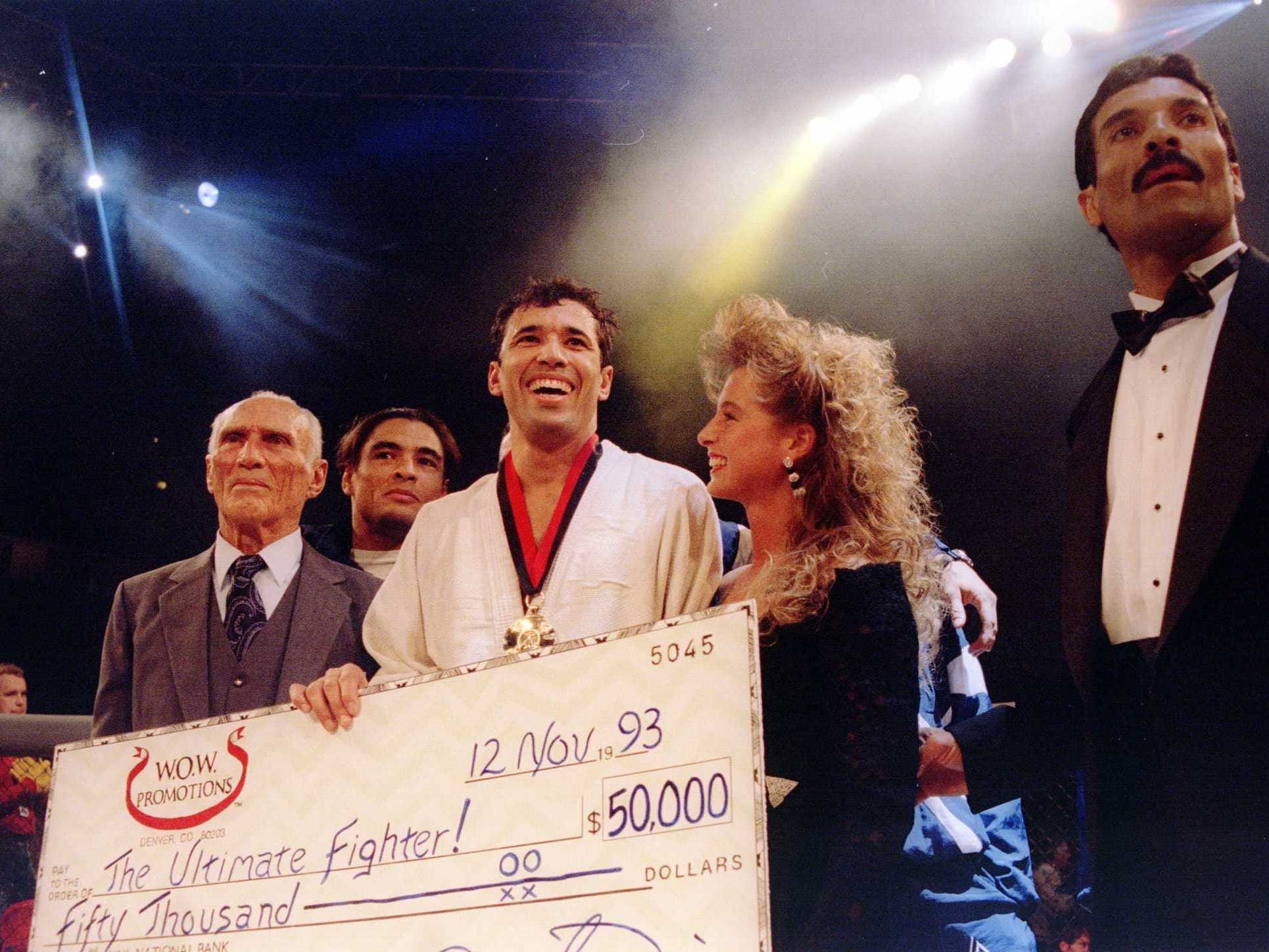
I still remember where I was when I caught the MMA bug.
It was 8th grade study period, and my buddy Jam and I were in the library pretending to study.
Our strategy was flawless in a way only a plan hatched by two thirteen-year-olds can be: side by side at a table against the wall, he occupied the inner seat with his iPod while I ran interference on the outside - a weighty copy of Stephen King’s The Stand blocking line of sight from any would-be narcs (sorry, Ms. Kelsey).

🐐🐐🐐
On this particular day it was not The Simpsons on the iPod, but a grainy, Limewire-procured recording from UFC 1, where a strange-looking man in a bathrobe named Royce Gracie deployed his mystical dark arts on his way to being crowned The Ultimate Fighter.
I was immediately hooked. What is this mystical power Gracie is using?! I asked Jam - earning a sharp hush and sideways glance for dramatic pretext: It was Brazilian Jiu Jitsu, he whispered.
My foray into Brazilian Jiu Jitsu is a story for another day. The point I’m making here is that in 1993, Royce Gracie was THE baddest man on the planet.
It didn’t matter that his punches looked like the weird thing your dog does with his paws when he gets impatient, or that despite the black belt around his waist Royce had apparently learned to throw kicks by watching aggrieved toddlers in high chairs. For his day and time, Royce was unbeatable - winning UFC 1, 2, AND 4 purely on the strength of his hitherto unknown grabby karate.
What on earth…
Fast forward thirty years and you can’t go to Kroger without running into a Gracie Barra. Your neighbors have had their kids (Jaxson and Braxton, naturally) in jiu jitsu since they were 4. The UFC is a billion-dollar franchise with enough prestige that the President regularly makes appearances - a long way indeed from John McCain’s 1996 dismissal of the sport as “human cockfighting.”
We all know the bar rises in sports - Joe Montana would have a pretty rough time against the 2025 Texans defense - but somehow when it comes to software and our livelihoods, we’re blind to the same forces, even as we benefit from them in everything else we buy.
Markets Arc Toward Efficiency
How many founders do you talk to who say they want to build “the next SalesForce”?
It’s particularly amusing when those same founders are customers of SalesForce - because when you ask them about the experience, it’s almost universally negative. The UI is lousy. It’s expensive. Nobody actually likes using it. The service sucks. Even if you forgot your renewal date, you could time it for thirty days after a generic email from a CSM, because you never hear from them otherwise.
Blah blah blah.
What those founders mean, of course, is that they want a company worth a kajillion dollars. A tower in San Francisco with a view of the Golden Gate. Tons and tons of employees serving absolutely everybody in every market with their super-cool software that obviously everybody wants because of how awesome it is.
Typical.
SalesForce, like Royce Gracie, is a relic from a different, less efficient era.
An era we are better for having ended.
In the early 2000s, the idea of software “in the cloud” was a genuinely novel concept. The slide below was used by SalesForce in 2003 to “name the undeniable shift in the world that creates both (a) big stakes and (b) huge urgency for your prospect” (Beechler, The (Second) Greatest Sales Deck and Pitch I’ve Ever Seen).
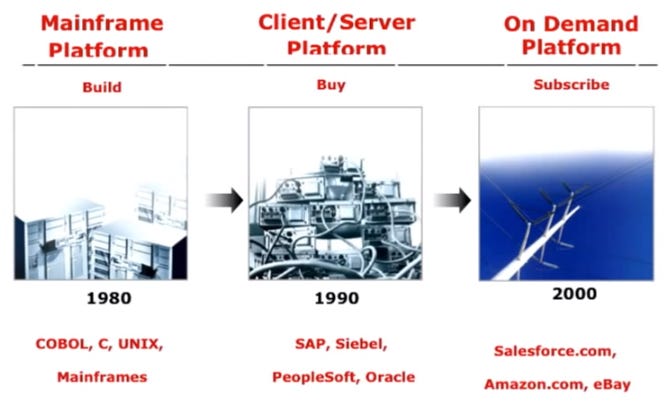
How quaint.
The cost of building, deploying, and supporting cloud software for enterprise was high enough that few companies attempted it - and the rewards were uncertain. Massive cost plus unknown payoff is a generally unappealing combination, even though in hindsight we paint those left standing as obvious bets. Survivorship bias is real: We remember Christopher Columbus and forget the dozen guys who attempted the same journey and ended up at the bottom of the ocean instead of in a textbook.
The reward, when it does work out, is that you’re the only game in town for a while. An enterprise that wanted to check out this newfangled “CRM” thing in 2002 really had one option - and they were going to pay for it in more ways than one.
Didn’t like the UI? Too damn bad.
Hard to use? Of course it is. People can hardly tell you what it is. (Cue the “What does Salesforce even do?” jokes)
Expensive? What’s the alternative?
Renew? Obviously. What are you going to do, build it yourself?
Proof of success is proof of rewards. And proof of rewards brings competition. ”Is this cloud software thing going to pan out?” becomes ”How do we take market share from these guys by being better and cheaper?”
As consumers, we love this. Consider the below: Today, you could buy not ONE but TWO color televisions from 1950 for the cost of a burrito from Chipotle. (Yes, I priced out the order for this article and now I’m hungry.)
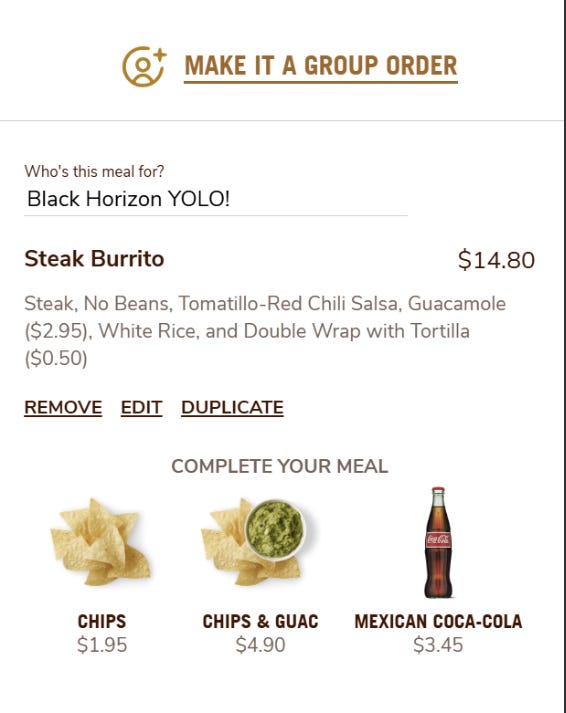
Yes, I know guac is extra.
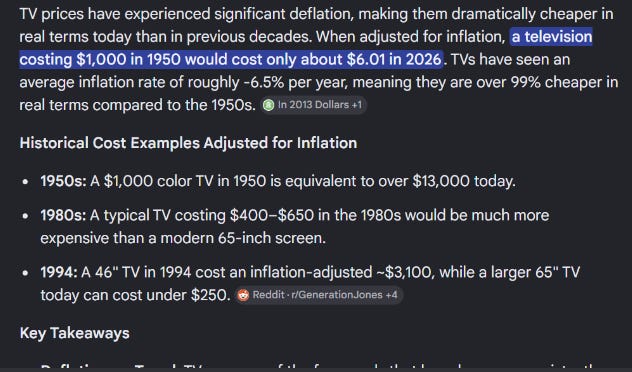
A TV in 1950 wasn’t $1000 because RCA was greedy. It was $1000 because the alternative was no television. By 1985 the alternative was Sony, Sharp, and Panasonic, and $500 became $200 became $80 became burrito. The same physics is about to land on enterprise software - and it is going to land much faster than it landed on television, because the barrier that protected the incumbents (build cost) just dropped by two orders of magnitude in a single year.
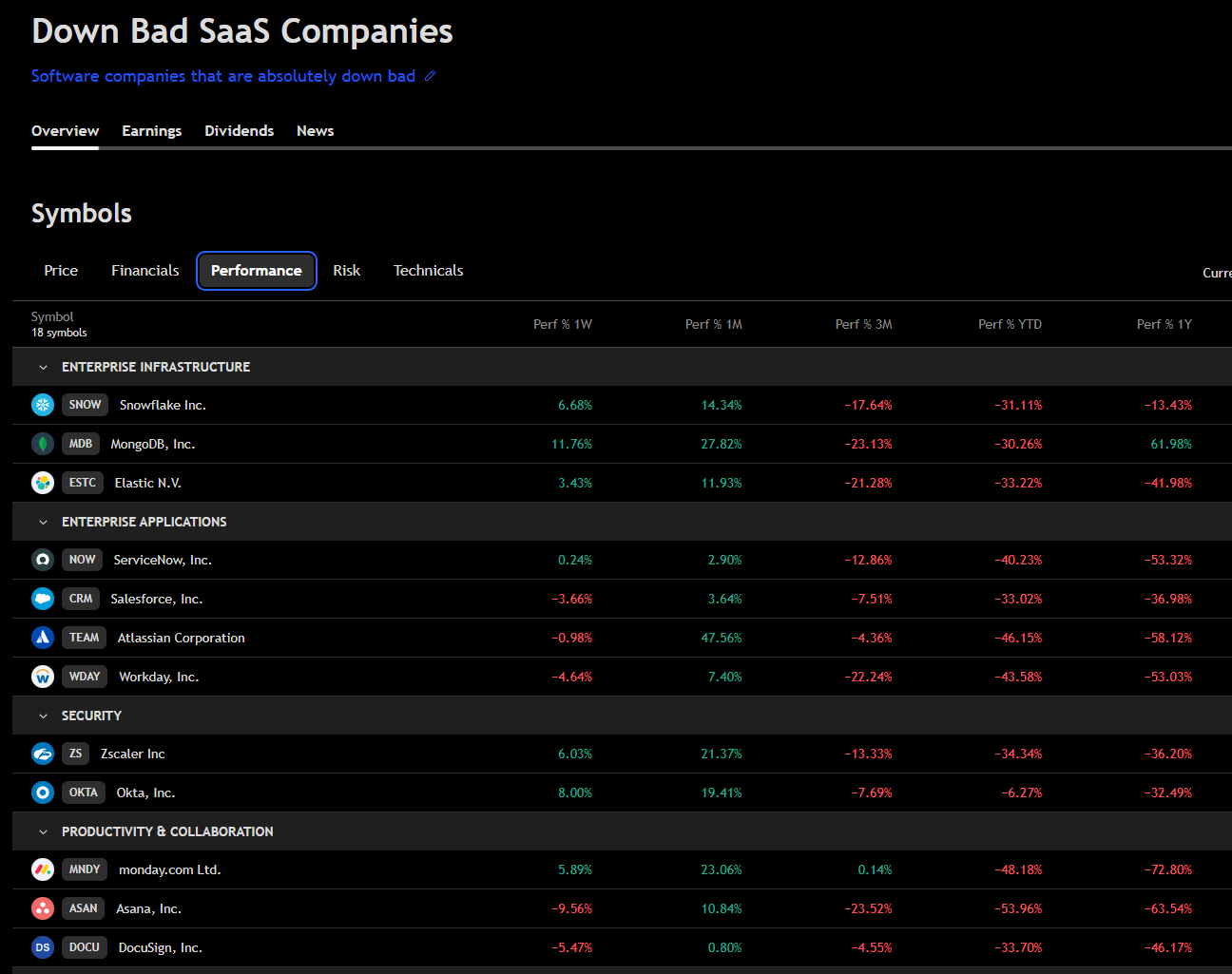
I recently co-opted the phrase “ai ya” from watching Chinese poker players, and no phrase could feel more appropriate.
For twenty years, the wall protecting the SalesForces of the world wasn’t really the product. It was the math. Building it yourself meant fifty engineers, three years, and $20MM - which meant you didn’t build it yourself, which meant you renewed. As of about February of this year, that math is gone. Small teams armed with AI tooling are now shipping in weeks what used to require a Series C and a year. That wall disappeared overnight.
Detroit, 1973
If you want to see what happens to an industry that runs unopposed for a couple of decades after that wall comes down, you don’t have to imagine. You can just look at Detroit.
In 1973, GM, Ford, and Chrysler sold roughly four out of every five cars bought in the United States. They had what is technically known in economics as a “fat oligopoly” and what I like to call “a really great gig if you can get it.”
They had spent thirty years not really competing with each other - three brands trading the same customers back and forth with mild variations on chrome, tailfin geometry, and which shade of beige the dashboard came in. The cars rusted out at 70,000 miles. The engines started in winter if the engine felt like it that day. Ford’s contribution to the era was a car that occasionally exploded if you rear-ended it. Chevy’s was a car so embarrassing they had to discontinue the model and pretend it never existed. If you complained at the dealership, the dealer shrugged. Where were you going to go?

Imagine parallel parking this bad boy
Then in 1982, Honda opened a factory in Marysville, Ohio. In 1988, Toyota opened one in Georgetown, Kentucky. The cars they sold did not fall apart at 70,000 miles. The engines started in winter regardless of mood. The doors closed with a satisfying thunk instead of the tinny rattle of a Pinto. By 2009 - about thirty years after Honda first showed up - both GM and Chrysler were in Chapter 11 bankruptcy, ultimately saved by the federal government with roughly $80 billion in taxpayer money.
The story was never that Americans got worse at building cars. Americans were never especially good at building cars; they just didn’t have to be. The customers were captive, the barrier to entry was high (a few billion dollars and a factory the size of a small city), and the moment the barrier came down - when Honda figured out you could just build the factory in Ohio instead of Yokohama - the rents ended very fast.
This is exactly the movie software is about to watch. SalesForce is GM. AI tooling is the Marysville plant.
What this means for the software company of tomorrow
Nassim Taleb wrote in the foreword to one of his books that after a talk, a man approached him and remarked that the talk was “very Taleb. Lots of problems, no solutions.” I brought this over to my wife, chuckling. Chuckling, that is, until she looked at me dead-pan, said “sounds like you,” and walked away.
So fine. Here are the solutions.
I cringe when I hear people say the “glory days of software” are over, because what they’re really saying is that the days of not working very hard, having exploitative pricing power, and offering undifferentiated value are over. Different sentence.
Competition in the next era of software will be defined by three things:
Doing more. The days of generic horizontal software are over. When your marquee feature is replicable in Claude Code in thirty minutes, it becomes a near-zero-marginal-cost commodity. The vendor that survives the next decade shows up as a partner with a point of view - one that executes outcomes, not one that ships a tool and books a renewal call eleven months later. The customer is not buying software anymore. They are buying expertise that runs. The moat becomes (1) know-how, and (2) proprietary data that can only be collected by operating inside of a niche, which leads us to....
For a smaller, more specific TAM. ...the unavoidable consequence. Expertise is deep by definition - you cannot have meaningful know-how about everything, only about a thing. Proprietary data is the same shape: The data that gives your software a real moat is data nobody else can collect, because nobody else is operating where you’re operating. Generic horizontal software cannot build either of those moats. It can only build features, and features are the thing AI just made free.
The company that wants to defend itself in 2030 has to pick a vertical and go all the way down into it - the construction subcontractors, the boutique law firms, the regional credit unions, the orthopedic surgery groups - somewhere specific enough that you can know your customer’s actual job better than they know it.
The old math was “if I have to spend $80M and seven years to build the product, the addressable market damn well better be a billion dollars or this whole exercise is silly.”
The new math is “if I can ship the product in six months with a team of nine, a $40M TAM is plenty’”
You are about to see a generation of companies do $20M ARR with twelve employees in verticals SalesForce has never heard of and will never bother to enter - not because they can’t, but because the unit economics of a $30 billion company forbid it. Big companies have to chase big markets.
And philosophically - thank God. A market made of a thousand sharp specialists who actually understand what their customers do is a vastly better market than a market made of one bloated generalist that even its own customers cannot describe. (”What does Oracle even do?”- every customer of Oracle.) The unbundling is good news for everyone except the unbundled.
For less money. Pricing power was always a function of captivity, and captivity was always a function of build cost. The 2003 SalesForce subscription wasn’t expensive because the software was good. It was expensive because the alternative was building it yourself, which we have now established was a non-starter for pretty much everyone.
Pull the build-cost number down by two orders of magnitude and the captivity goes with it. The captive customer becomes the shopping customer. The shopping customer compares vendors. Vendors compete on price. Price drops. None of this is optional. It is the same gravity that took your father’s color television from $1000 to a burrito. The people complaining loudest are the people who got used to taking the elevator up.
The elevator is broken. The stairs are still right there.
How real businesses have always worked
If this sounds like it sucks, (1) you probably sell software, and (2) welcome to business as usual for the rest of the world.
It is a relatively recent phenomenon that the default expectation for a startup was to take a giant pile of money and light it on fire in the name of top-line revenue growth at the expense of everything else.
Before approximately 1995 - when a group of people from Stanford decided that spending less than you make and reinvesting the difference was much too straightforward - this was the modus operandi of literally every business that has ever existed.
It’s funny watching even this elementary fact of commerce require proprietary jargon to be acceptable to the VC hive-mind. I’ve heard multiple stories of founders being asked to report on “revenue per employee” by the same investors who, a week earlier, were asking when they could hire another twenty AEs.
The winners of the next decade will be lean by design. They will serve a specific vertical with religious focus, weaponize that focus into pricing power the incumbents structurally cannot match, and accept - even celebrate - that their product is not for everybody. It is everything for the right somebody.
The rest of the business world has been running this play for two thousand years. Software is finally invited.